

The Hidden Economics of AI ERP – Are We Creating a New Cost Problem?
2 mins read
For twenty years, the technology industry sold a simple message. Software would reduce costs. Cloud software would reduce infrastructure costs. Automation would reduce labour costs. Now AI is being sold as the next stage of that journey. But a difficult question is emerging. What if AI reduces some costs while simultaneously creating entirely new categories…
For twenty years, the technology industry sold a simple message.
Software would reduce costs.
Cloud software would reduce infrastructure costs.
Automation would reduce labour costs.
Now AI is being sold as the next stage of that journey.
But a difficult question is emerging.
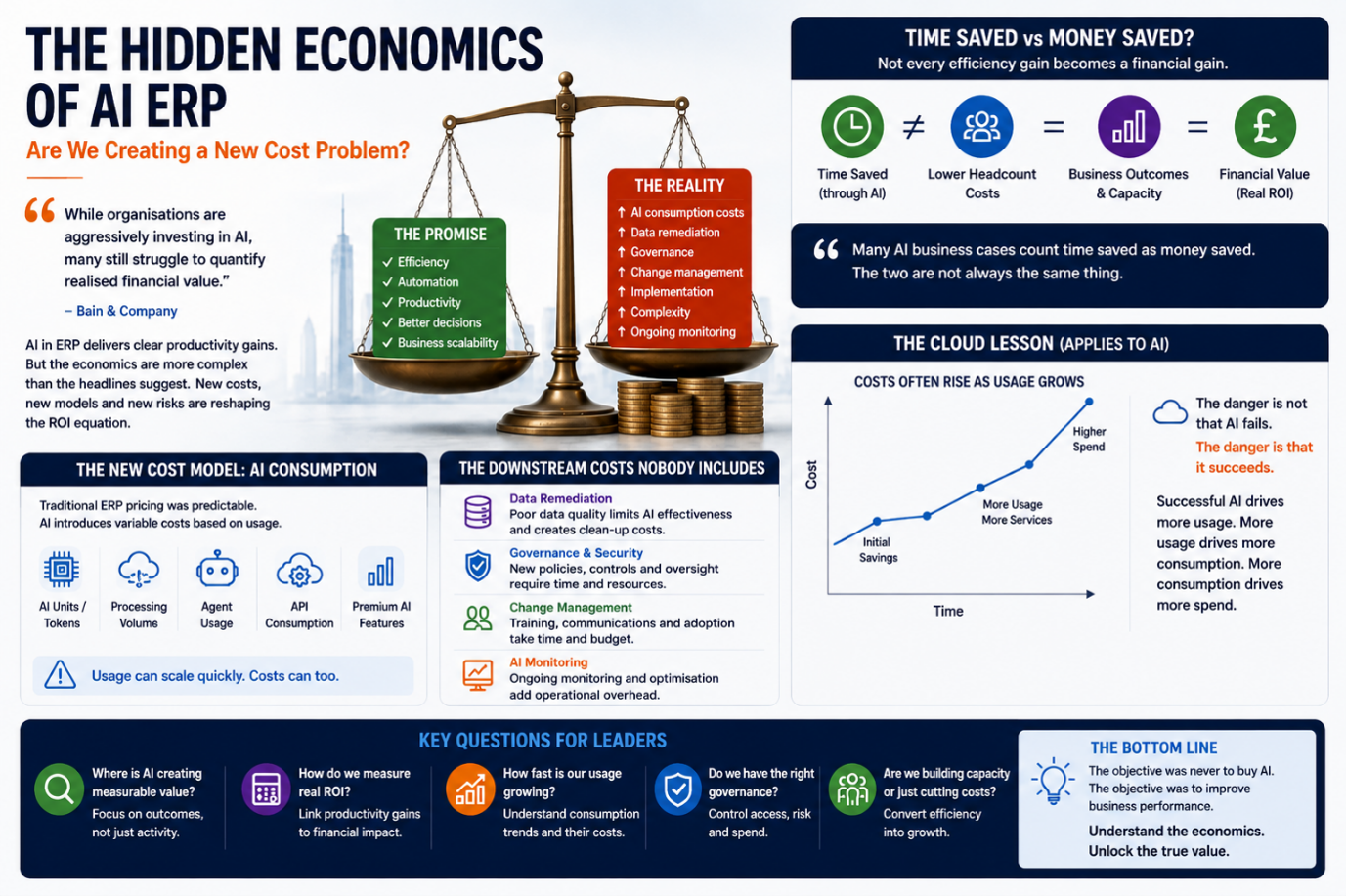
What if AI reduces some costs while simultaneously creating entirely new categories of expenditure?
Across SAP, Oracle Fusion and Microsoft Dynamics 365 Business Central, the AI proposition appears compelling.
Yet many organisations are struggling with a fundamental issue.
How do you measure the value?
What customers say they like
SAP customer examples include De Agostini reporting approximately 500 hours saved every month and Team Liquid reporting the elimination of approximately 10,000 hours of manual effort.
Those numbers are impressive.
But what do they actually mean financially?
This is where many organisations begin to struggle.
The employee versus AI equation
Consider a finance administrator earning £40,000 per year.
If AI saves 20% of that person’s time, has the organisation saved £8,000?
Not necessarily.
The employee still receives the same salary.
The organisation only benefits financially if that efficiency creates measurable capacity, revenue growth or avoided hiring costs.
Many AI business cases count time saved as money saved.
The two are not always the same thing.
Bain & Company has highlighted that while organisations are aggressively investing in AI, many continue to struggle to demonstrate realised financial value beyond productivity improvements.
The distinction matters.
Productivity is not the same as profit.
The downstream costs nobody includes
Many organisations underestimate:
- Data remediation
- Governance
- Security controls
- Change management
- AI monitoring
- Usage management
- Consumption charges
The result is that AI projects frequently cost more than anticipated.
Not because the technology fails.
But because successful adoption creates additional demand.
The cloud lesson
Many organisations believed cloud computing would dramatically reduce costs.
Initially, it often did.
Then workloads increased.
Storage expanded.
Integrations multiplied.
Monthly bills grew.
AI may follow the same pattern.
The danger is not that AI fails.
The danger is that it succeeds.
Successful AI adoption drives more usage.
More usage drives more consumption.
More consumption drives more spending.
The challenge facing CIOs and CFOs is understanding where that curve stops.
Because the objective was never to buy artificial intelligence.
The objective was to improve business performance.

Be in the know!
Subscribe to our monthly newsletter!