


Recruitment’s AI Reality Check – Why Data Quality and Process Design Matter More Than the Model
3 mins read
The recruitment industry has spent the last two years discussing artificial intelligence. Every technology provider has an AI strategy. Every conference agenda includes AI sessions. Every software roadmap contains AI features. And every recruitment leader is asking the same question. Will AI fundamentally change recruitment? The answer is yes. But perhaps not in the way…
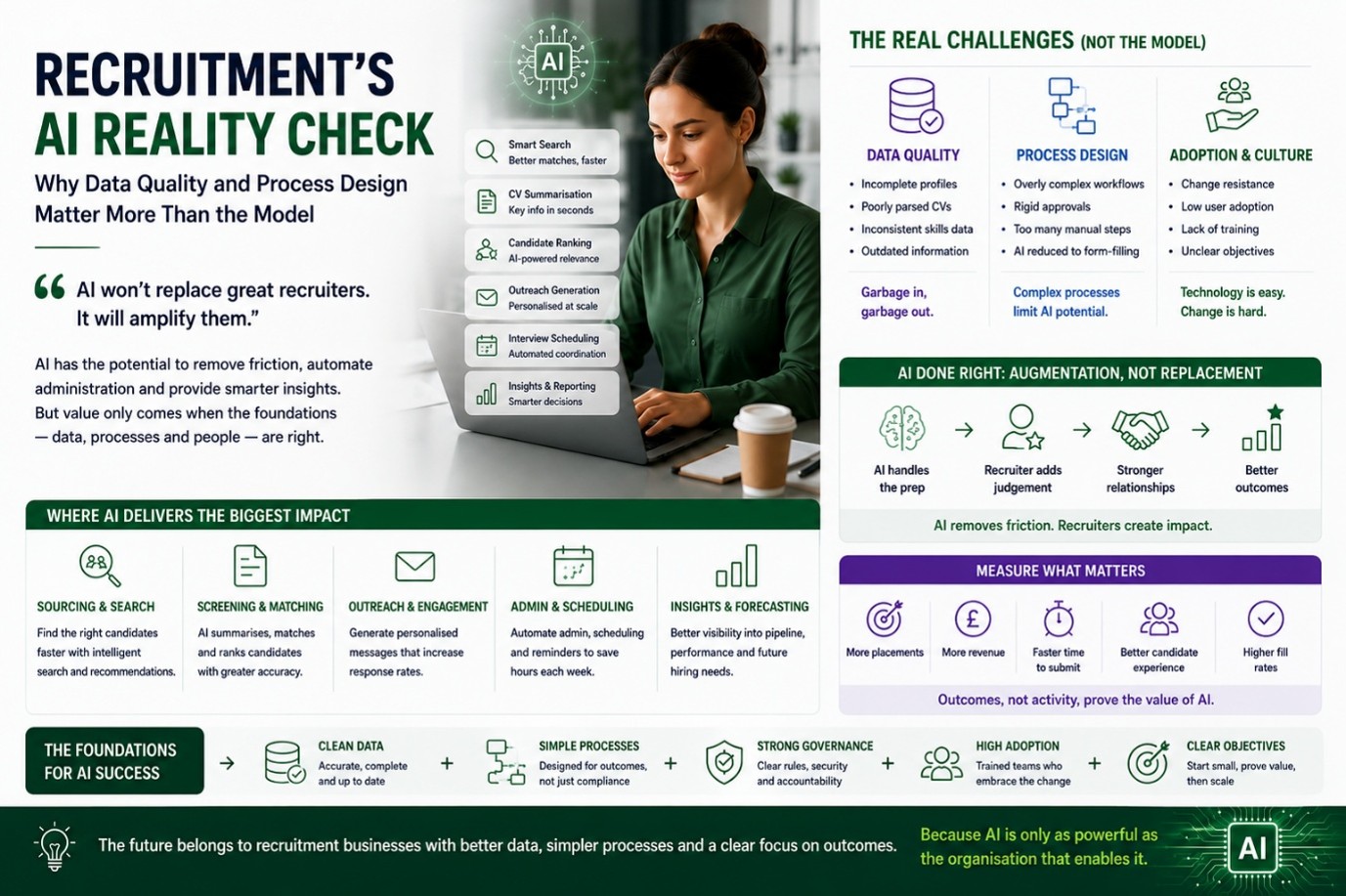
The recruitment industry has spent the last two years discussing artificial intelligence.
Every technology provider has an AI strategy.
Every conference agenda includes AI sessions.
Every software roadmap contains AI features.
And every recruitment leader is asking the same question.
Will AI fundamentally change recruitment?
The answer is yes.
But perhaps not in the way many people expect.
The industry is focused on the wrong challenge
Most discussions focus on the model.
Which model is best?
Which model is fstest?
Which model produces the highest quality output?
The reality is that most recruitment businesses are not constrained by model capability.
They are constrained by data quality.
A large language model can only work with the information it receives.
Incomplete records create incomplete outcomes.
Poorly parsed CVs reduce matching accuracy.
Outdated candidate information limits relevance.
Inconsistent skills data reduces search quality.
The technology is rarely the bottleneck.
The data usually is.
Recruitment is perfectly suited to AI
Recruitment contains a large volume of repetitive, information-driven work.
Searching.
Matching.
Screening.
Summarising.
Outreach.
Reporting.
Scheduling.
Administration.
These activities are highly suitable for AI assistance.
The opportunity is not to replace recruiters.
The opportunity is to remove friction.
The process problem
Many recruitment businesses have spent years adding workflows, approvals, mandatory fields and controls.
Most were introduced for sensible reasons.
However, complexity creates limitations.
AI performs best when processes are simple and information is accessible.
The more restrictive the process, the more limited the AI becomes.
Some organisations inadvertently reduce AI to an advanced form-filling tool.
Others redesign processes so AI can genuinely assist decision making.
The difference in outcomes can be significant.
Measuring what matters
One of the biggest mistakes organisations make is measuring time saved rather than business outcomes.
Saving thirty minutes per day sounds valuable.
But what happens next?
More placements?
More revenue?
Improved fill rates?
Better candidate experience?
The true value of AI is not measured in hours.
It is measured in outcomes.
The future belongs to organisations with better data
The recruitment firms that benefit most from AI will not necessarily be those with the most advanced technology.
They will be those with:
- Better data
- Cleaner processes
- Stronger governance
- Higher adoption
- Clearer objectives
The future of recruitment will not be determined by who owns the best AI model.
It will be determined by who creates the environment where AI can deliver value.
Because artificial intelligence is only as effective as the organisation that enables it.

Be in the know!
Subscribe to our monthly newsletter!