

The Factory That Learns – Can AI Solve Manufacturing’s Greatest Challenges?
2 mins read
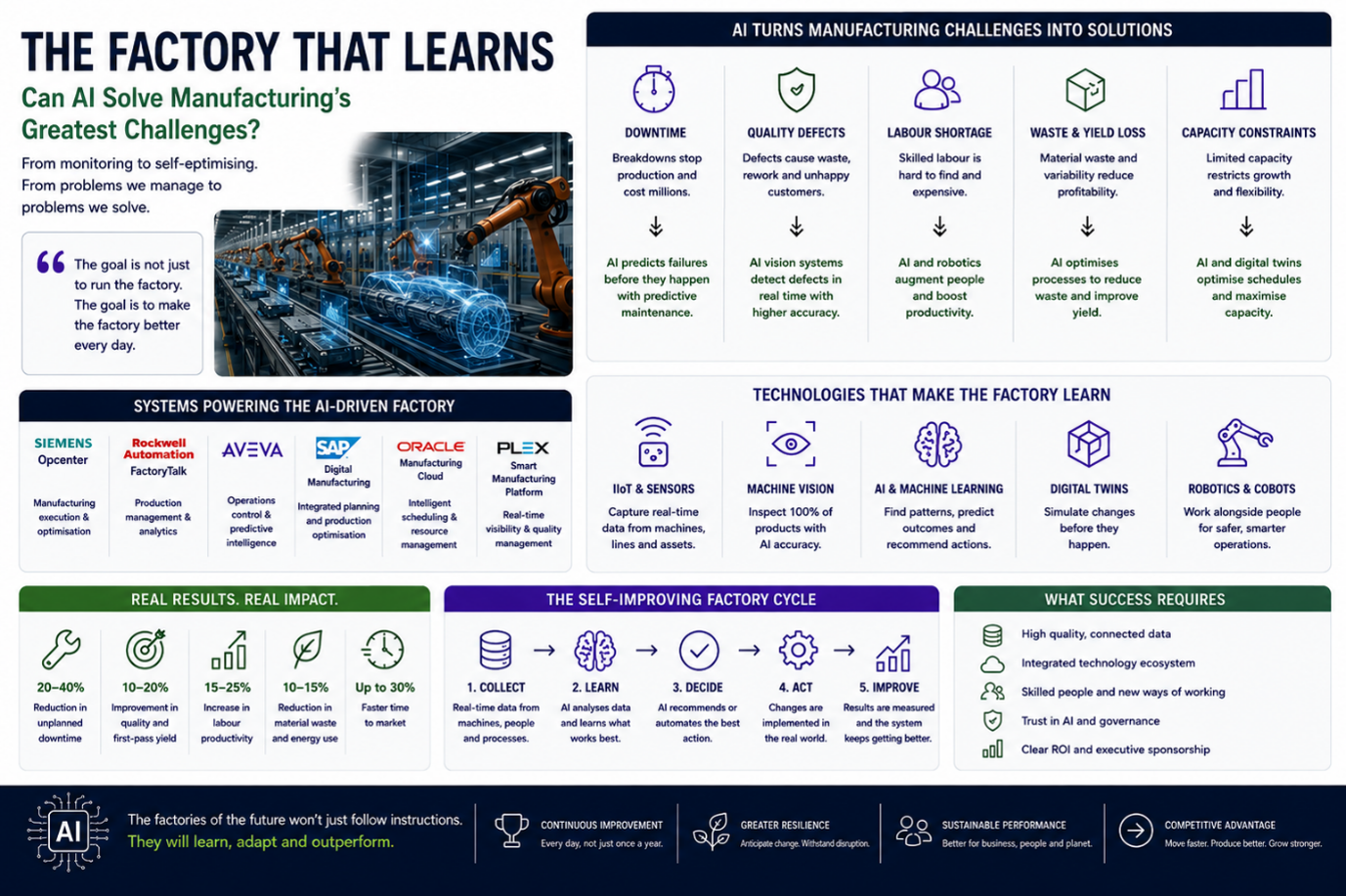
Manufacturing has spent more than a century attempting to solve the same problems. Downtime. Quality defects. Equipment failure. Waste. Capacity constraints. Labour shortages. These challenges remain among the most expensive operational issues facing businesses today. Artificial intelligence may finally provide a path towards solving them. The downtime challenge Unplanned downtime remains one of manufacturing’s most…
Manufacturing has spent more than a century attempting to solve the same problems.
Downtime.
Quality defects.
Equipment failure.
Waste.
Capacity constraints.
Labour shortages.
These challenges remain among the most expensive operational issues facing businesses today.
Artificial intelligence may finally provide a path towards solving them.
The downtime challenge
Unplanned downtime remains one of manufacturing’s most expensive problems.
A single failure can stop production lines, delay deliveries and increase operational costs.
Traditional maintenance strategies have relied on schedules.
Machines are serviced whether they need maintenance or not.
AI introduces a different model.
Platforms such as Siemens Opcenter, AVEVA and SAP Digital Manufacturing increasingly use predictive maintenance.
The objective is simple.
Repair assets before they fail.
For many manufacturers this represents one of the clearest AI business cases available today.
The quality problem
Quality control has traditionally relied heavily on human inspection.
Humans become tired.
Humans miss defects.
Humans vary in consistency.
AI-powered machine vision systems from Cognex, Landing AI and Keyence are changing this.
The technology can inspect products continuously.
The technology improves over time.
Most importantly, the technology creates consistency.
The labour shortage challenge
Many manufacturers face a growing shortage of skilled labour.
The issue is particularly acute among maintenance engineers, machine operators and technical specialists.
Collaborative robotics from ABB, Fanuc, KUKA and Universal Robots are increasingly helping manufacturers address this challenge.
Rather than replacing workers entirely, these systems augment human capability.
The result is higher productivity with fewer staffing constraints.
Can factories optimise themselves?
This may be the most important question of all.
Digital twins from Siemens, Dassault Systèmes and PTC allow manufacturers to simulate production environments before making physical changes.
Combined with AI, factories can increasingly evaluate:
- Scheduling decisions
- Capacity changes
- Product designs
- Energy consumption
- Resource allocation
The vision is a factory that continuously learns.
A factory that becomes more efficient every day.
A factory that identifies improvement opportunities without waiting for human analysis.
The next industrial revolution
The first industrial revolution mechanised work.
The second electrified it.
The third digitised it.
The fourth connected it.
The fifth may be something entirely different.
A world where factories do not simply execute instructions.
They learn from experience.
And for the first time, some of manufacturing’s oldest challenges may no longer be unavoidable.

Be in the know!
Subscribe to our monthly newsletter!