

The Impossible Store – Can AI Finally Solve Retail’s Unsolvable Problems?
2 mins read
Retail has spent decades managing problems that nobody has ever truly solved. Out-of-stocks. Shoplifting. Demand forecasting. Product availability. Labour scheduling. Waste. Every retailer experiences them. Every retailer invests millions attempting to reduce them. Yet they continue to exist. The reason is simple. Most retail systems have historically been reactive. They tell managers what happened. Artificial…
Retail has spent decades managing problems that nobody has ever truly solved.
Out-of-stocks.
Shoplifting.
Demand forecasting.
Product availability.
Labour scheduling.
Waste.
Every retailer experiences them.
Every retailer invests millions attempting to reduce them.
Yet they continue to exist.
The reason is simple.
Most retail systems have historically been reactive.
They tell managers what happened.
Artificial intelligence is introducing something different.
Systems that can predict what will happen next.
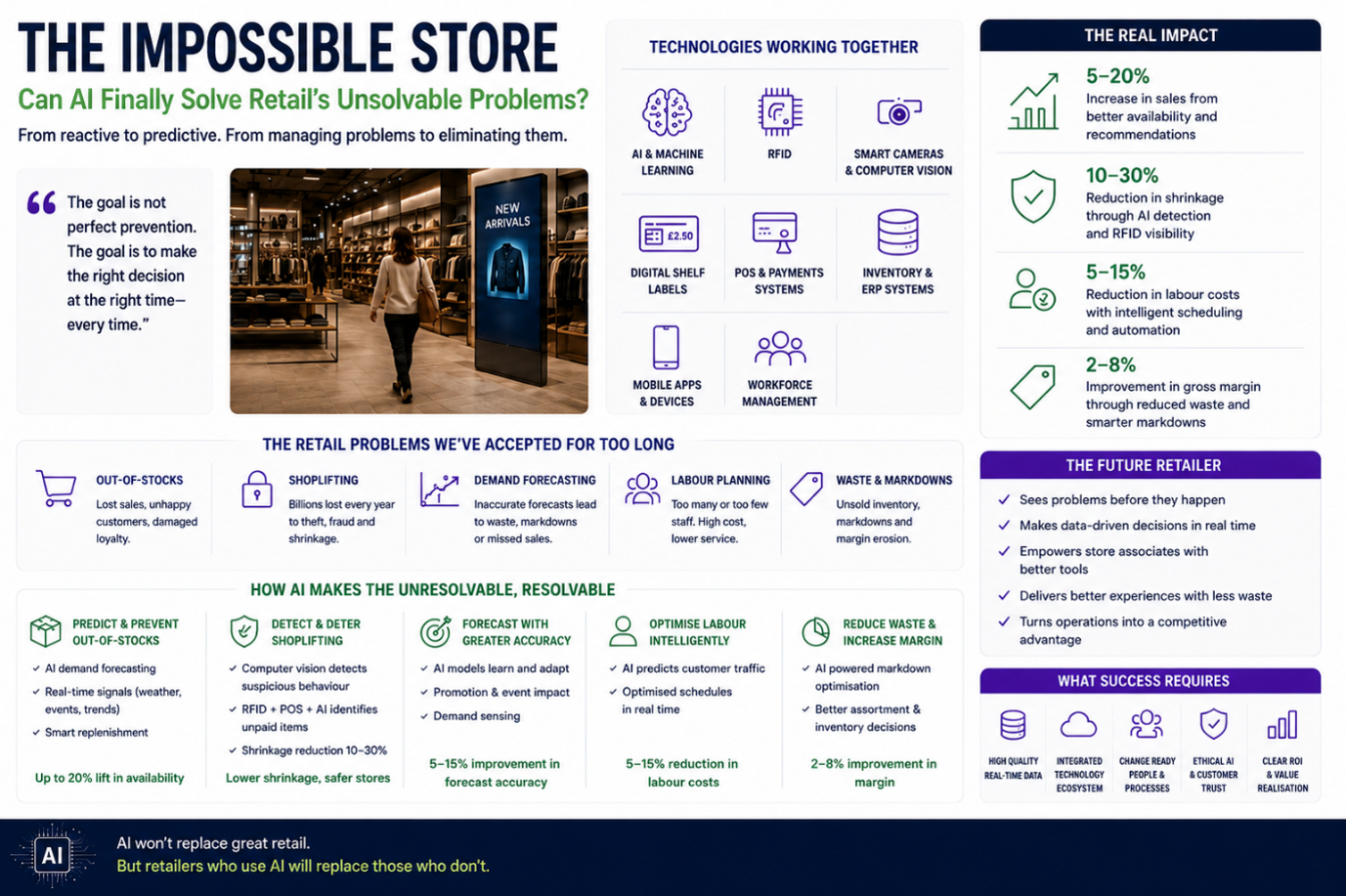
The out-of-stock problem
Retailers have accepted stock-outs as a fact of life.
A customer arrives.
The product is unavailable.
The sale is lost.
Historically the retailer only discovers the issue after it occurs.
Modern platforms such as Blue Yonder, SAP Retail, Oracle Retail and Manhattan Active are attempting to change this.
AI now analyses:
- Historical sales
- Weather forecasts
- Promotions
- Local events
- Economic conditions
- Social media activity
The goal is not forecasting demand.
The goal is forecasting demand accurately enough to prevent empty shelves.
The real question is whether stock-outs become an operational failure rather than an unavoidable consequence of retailing.
Can AI make shoplifting uneconomic?
The objective may not be stopping every theft.
The objective may be making theft significantly more difficult.
Computer vision systems from companies such as Trigo, Standard AI and Everseen increasingly combine with RFID, POS systems and inventory platforms.
For the first time retailers can see:
- What left the shelf
- What reached the checkout
- What was paid for
- What left the store
Historically retailers conducted investigations after losses occurred.
AI allows investigation during the event itself.
The result is not perfect prevention.
The result is significantly improved detection.
The labour planning challenge
Retail labour scheduling has traditionally relied on experience.
Managers predict customer traffic.
Managers schedule employees.
Managers react when reality differs from expectations.
AI is changing this process.
Platforms such as Blue Yonder Workforce Management increasingly use machine learning to predict:
- Customer traffic
- Queue formation
- Seasonal demand
- Staffing requirements
The result may be one of retail’s largest opportunities.
The ability to optimise labour without reducing customer service.
The bigger opportunity
The most significant retail question may no longer be:
How do we manage operational problems?
Instead it becomes:
Can we eliminate them altogether?
For the first time in retail history, that possibility appears realistic

Be in the know!
Subscribe to our monthly newsletter!