

The Self-Healing Supply Chain – Can AI Eliminate Disruption Before It Happens?
2 mins read
For decades supply chain management has focused on responding to disruption. Factories close. Ships are delayed. Demand changes. Suppliers fail. The challenge has always been speed of response. Artificial intelligence introduces a different possibility. What if disruption could be anticipated before it occurs? The problem supply chains never solved Every supply chain professional understands the…
For decades supply chain management has focused on responding to disruption.
Factories close.
Ships are delayed.
Demand changes.
Suppliers fail.
The challenge has always been speed of response.
Artificial intelligence introduces a different possibility.
What if disruption could be anticipated before it occurs?
The problem supply chains never solved
Every supply chain professional understands the challenge.
Information arrives too late.
By the time a shortage is identified, inventory has already been impacted.
By the time a supplier issue becomes visible, production may already be at risk.
Traditional systems provide visibility.
AI is increasingly providing prediction.
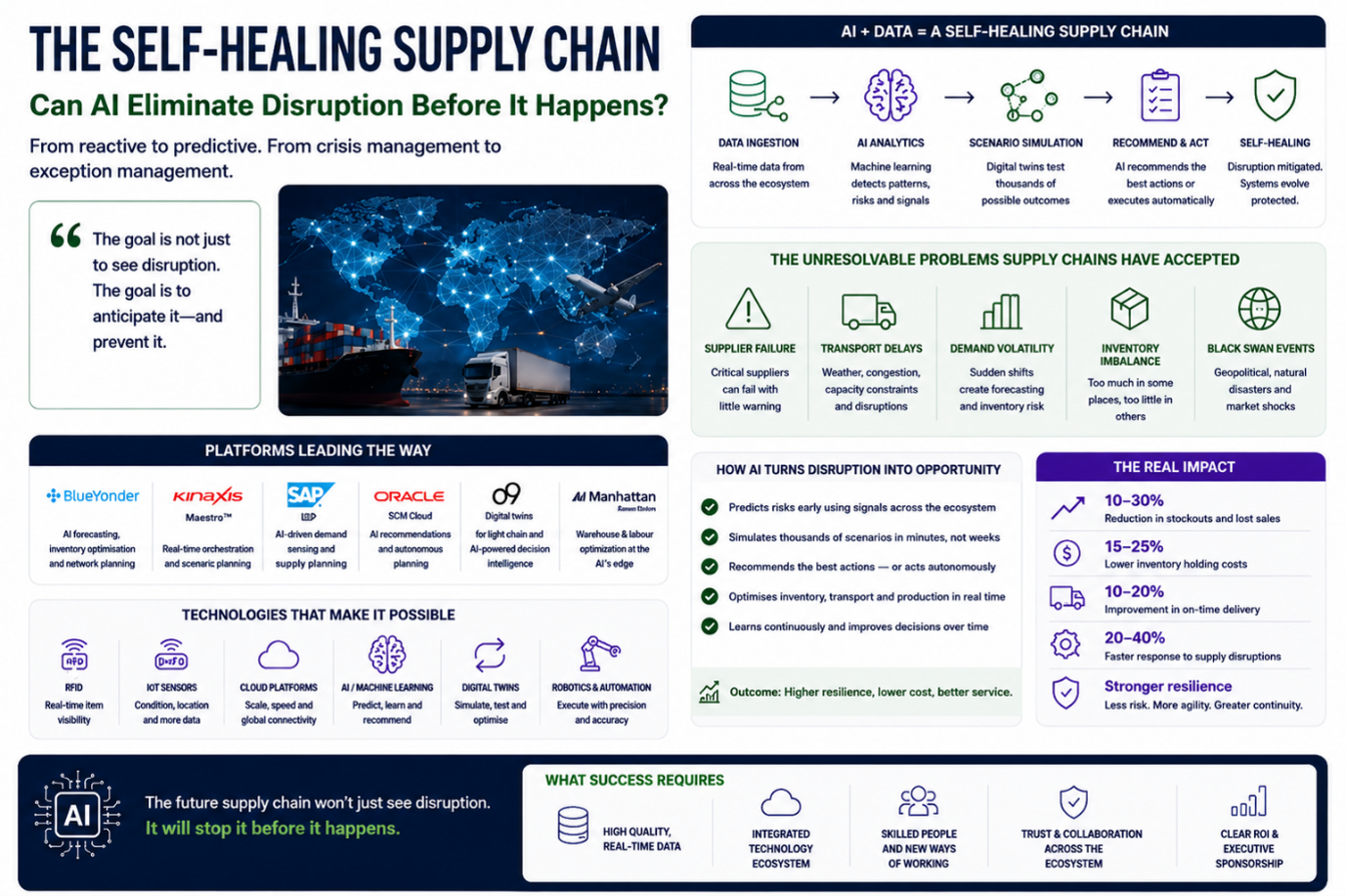
Platforms such as Kinaxis Maestro, SAP IBP, Oracle SCM and o9 Solutions are moving towards what many analysts describe as self-healing supply chains.
The rise of digital twins
One of the most powerful technologies emerging in supply chain management is the digital twin.
Digital twins create virtual representations of:
- Inventory networks
- Warehouses
- Suppliers
- Transportation systems
When AI analyses these environments it can simulate thousands of possible scenarios.
Questions that once required weeks of analysis can now be evaluated in minutes.
What happens if a supplier fails?
What happens if fuel costs increase?
What happens if demand suddenly doubles?
Historically these questions were difficult to answer.
AI increasingly makes them routine.
Can shortages become predictable?
Supply chain leaders have spent decades accepting shortages as unavoidable.
AI challenges this assumption.
Modern systems increasingly combine:
- RFID
- IoT sensors
- Warehouse data
- Supplier data
- Market signals
The objective is not identifying shortages.
The objective is preventing them.
If successful, supply chains may move from crisis management to exception management.
The future supply chain
The ultimate vision is not automation.
It is autonomy.
A supply chain that identifies risk, evaluates options and recommends corrective action before disruption occurs.
That future is still emerging.
But for the first time it appears technically achievable.

Be in the know!
Subscribe to our monthly newsletter!