

The ERP AI Promise – Why Technology Costs Are Rising Faster Than Ever
4 mins read
For decades, technology vendors have sold a simple vision. Invest more in software today and reduce operational costs tomorrow. From the introduction of ERP systems in the 1990s to the cloud transformation of the last fifteen years, organisations have repeatedly been told that the next wave of technology would make businesses leaner, more efficient and…
For decades, technology vendors have sold a simple vision.
Invest more in software today and reduce operational costs tomorrow.
From the introduction of ERP systems in the 1990s to the cloud transformation of the last fifteen years, organisations have repeatedly been told that the next wave of technology would make businesses leaner, more efficient and easier to manage.
Now artificial intelligence has become the latest chapter in that story.
SAP, Oracle Fusion and Microsoft Dynamics 365 Business Central are investing billions in AI capabilities, embedding assistants, agents and automation directly into their core applications. The expectation is clear. Businesses will spend more on technology but require fewer resources to perform repetitive, administrative and analytical work.
Microsoft CEO Satya Nadella summarised the scale of the shift when he stated:
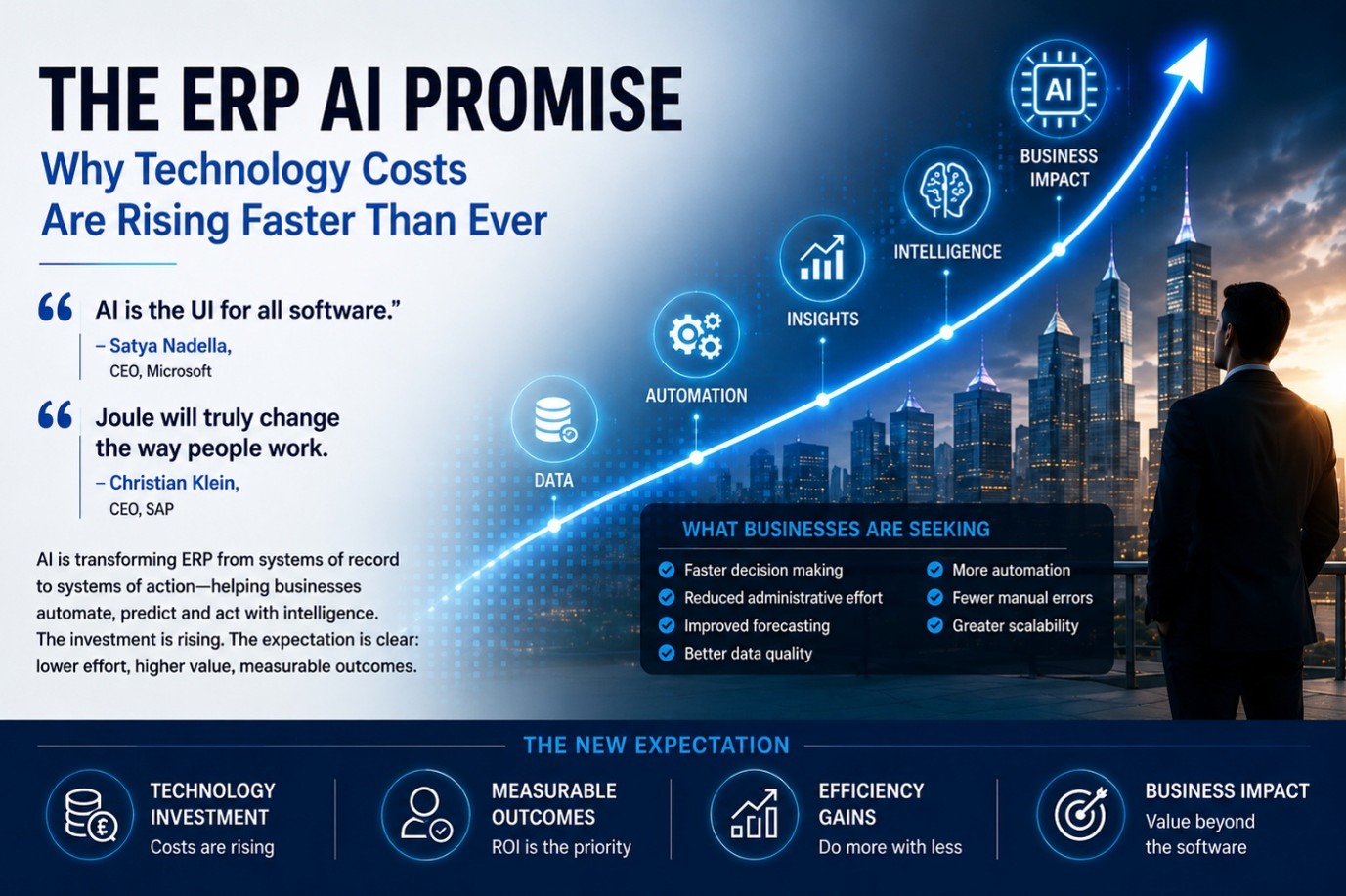
“AI is the UI for all software.”
That statement represents a fundamental change in how enterprise software is expected to operate. Systems are no longer simply repositories of information. They are increasingly expected to understand context, provide recommendations and automate work.
The question is whether the promise matches reality.
Why ERP vendors are betting everything on AI
ERP systems have traditionally been systems of record.
They stored transactions, maintained master data and provided reporting.
The challenge was that users still had to do much of the work themselves.
Employees searched for information.
Employees created reports.
Employees processed invoices.
Employees reconciled accounts.
Employees investigated exceptions.
Employees interpreted the data.
AI changes that equation.
Rather than simply storing information, ERP systems are increasingly being designed to assist, recommend and automate.
SAP has introduced Joule, its enterprise AI assistant, alongside a growing portfolio of Joule Agents designed to perform tasks across finance, procurement, supply chain and human resources.
SAP CEO Christian Klein described the ambition clearly:
“Joule will truly change the way people work.”
Oracle Fusion has embedded AI throughout its ERP platform with specialist agents for payables, expenses, payments and financial management.
Microsoft Dynamics 365 Business Central has incorporated Copilot into daily workflows, enabling users to generate content, analyse information and automate routine activities.
The common objective is simple.
Reduce the amount of time employees spend interacting with systems and increase the amount of value they create.
The growing cost of technology
There is, however, a contradiction emerging within the market.
Technology costs are increasing.
Cloud subscription fees continue to rise.
AI features are increasingly premium services.
Consumption-based pricing models are becoming common.
Implementation costs remain significant.
At the same time organisations face pressure to improve productivity, control labour costs and manage economic uncertainty.
This creates a new expectation for technology leaders.
Software must now demonstrate measurable business outcomes.
It is no longer enough for an ERP system to process transactions correctly.
It must actively contribute to efficiency gains.
A finance department may tolerate increased technology expenditure if invoice processing times are reduced by 50%.
A procurement team may justify additional software costs if supplier analysis becomes largely automated.
A CFO may support investment if headcount growth can be avoided while transaction volumes increase.
The conversation is no longer about functionality.
It is about return on investment.
What organisations are hoping to achieve
Across most ERP environments, AI is being introduced to address similar challenges.
Businesses want:
- Faster decision making
- Reduced administrative effort
- Improved forecasting
- Better data quality
- More automation
- Fewer manual errors
- Greater operational scalability
These objectives are particularly attractive because many organisations have already completed the obvious stages of digital transformation.
Most businesses have already implemented ERP.
Most have already migrated significant workloads to the cloud.
The next productivity gains are increasingly expected to come from automation and AI.
In theory, this should allow organisations to grow without increasing support functions at the same rate.
That is the economic argument driving current investment.
The real test
The challenge for organisations is that AI is still relatively new within enterprise applications.
Many companies remain in the early stages of adoption.
Some are achieving measurable efficiency gains.
Others are still experimenting.
Most are attempting to understand where the value will ultimately emerge.
What is clear is that AI has moved beyond being a future capability.
It is now central to the ERP strategies of SAP, Oracle and Microsoft.
The organisations that benefit most will not necessarily be those that buy the most technology.
They will be those that understand where AI genuinely improves productivity and where it simply adds another layer of complexity.

Be in the know!
Subscribe to our monthly newsletter!